

The preseason polls agree on the five teams at the top of college football. They just disagree slightly on the order.
The Associated Press has Ohio State No. 1, Oregon No. 2, Georgia No. 3, Notre Dame No. 4 and Texas No. 5. The Coaches Poll has the same five teams, with Ohio State No. 1, Oregon No. 2, Georgia No. 3, Texas No. 4 and Notre Dame No. 5.
But while the five teams might begin the season clustered together, their roads through the 2026 season look dramatically different.
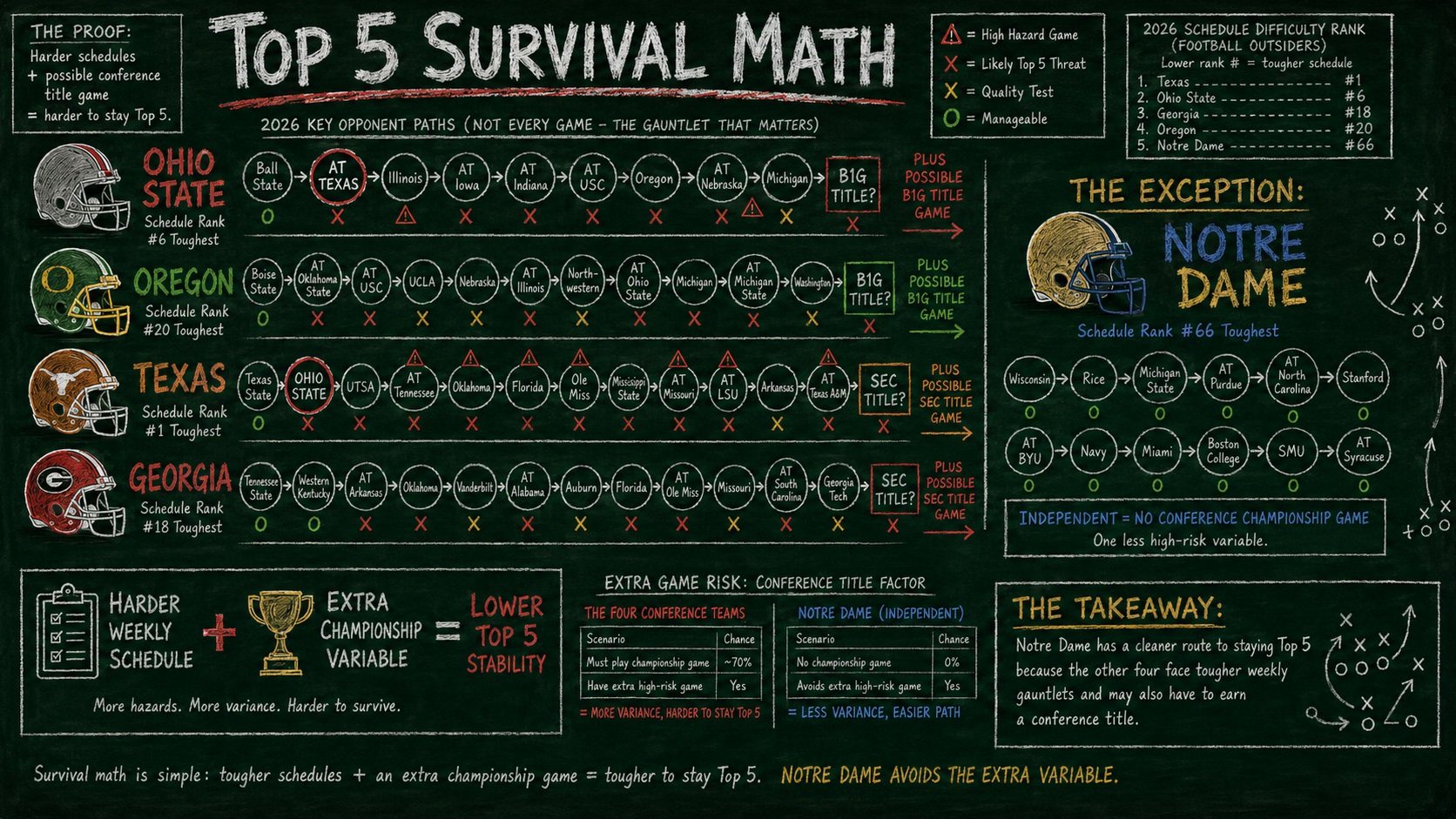
Ohio State, Oregon, Georgia and especially Texas face schedules filled with games capable of knocking them out of the Top Five. Notre Dame has challenges of its own, but the Fighting Irish have something the other four largely do not: weeks of separation between their most dangerous opponents and far fewer games against teams currently considered national contenders.
That could make Notre Dame the easiest of the five to keep near the top of the rankings throughout the season.
Texas Faces the Most Dangerous Road of All
No Top Five team faces a more unforgiving schedule than Texas.
Phil Steele ranks the Longhorns' 2026 schedule the toughest in the country. Texas plays 10 Power-conference opponents, and its schedule includes Ohio State, Tennessee, Oklahoma, Ole Miss, LSU and Texas A&M among teams projected in the preseason Top 25.
And that does not fully capture how difficult the sequence is.
Texas hosts No. 1 Ohio State on September 12. Two weeks later, the Longhorns travel to Tennessee. Then comes Oklahoma in Dallas, followed by Florida and Ole Miss. November includes trips to Missouri and LSU before the regular season concludes at Texas A&M.
There are very few places for Texas to hide.
A team can be legitimately excellent and still lose two or three games against that schedule. More importantly for the weekly rankings, Texas will repeatedly enter Saturdays knowing that one bad afternoon could send it tumbling several positions.
The Longhorns may actually be better than their final record eventually suggests.
Ohio State Has Multiple Top-Five-Level Showdowns
Ohio State starts at No. 1 in both polls, but maintaining that position could be considerably harder than earning it in August.
The Buckeyes travel to Texas in just their second game. Later they visit Iowa, defending national champion Indiana and USC. Then Oregon comes to Columbus on November 7 before Ohio State closes the season against Michigan.
Phil Steele ranks Ohio State's schedule sixth toughest nationally, with 10 Power-conference games.
The stretch from October into November is particularly threatening. Ohio State plays at Indiana on October 17, at USC on October 31 and then hosts Oregon one week later.
That means even if the Buckeyes survive Texas in September, the No. 1 ranking could remain under constant pressure.
Ohio State could be one of the best teams in the country and still find itself entering November at 7-1 or leaving the Oregon game at 8-2.
Neither record would eliminate the Buckeyes from national championship contention. It could, however, make staying in the Top Five difficult.
Oregon's November Could Reshape the Rankings
Oregon has a somewhat easier first half, but the Ducks eventually run directly into the strength of the Big Ten.
They travel to USC to begin conference play, then later face a November stretch featuring at Ohio State, Michigan at home, at Michigan State and Washington at home.
Phil Steele ranks Oregon's schedule No. 20 nationally.
That may not sound overwhelming compared with Texas or Ohio State, but Oregon's biggest problem is concentration.
The Ducks could enter November undefeated and ranked No. 1 or No. 2, yet still face several games capable of changing their season in less than a month. Going to Columbus to face Ohio State followed immediately by Michigan is exactly the type of back-to-back challenge that makes maintaining an undefeated record extraordinarily difficult.
For Oregon, the question may not be whether the Ducks are good enough for the Top Five. It may be whether anyone can navigate that November without taking a loss.
Georgia Gets the SEC Grind
Georgia's schedule begins comfortably with Tennessee State and Western Kentucky.
Then the SEC arrives.
The Bulldogs travel to Arkansas, host Oklahoma, visit Alabama, face Florida in Atlanta, travel to Ole Miss and later go to South Carolina. Missouri and Georgia Tech are also waiting in November.
Phil Steele ranks Georgia's schedule No. 18 nationally.
Georgia's problem is familiar to SEC contenders: there are too many opponents capable of turning an average performance into a loss.
Oklahoma is currently No. 10 in the AP poll. Ole Miss is No. 9. Alabama is No. 13. Missouri is No. 25. Even traditionally dangerous opponents such as Florida, Auburn, Arkansas and South Carolina do not need to be nationally ranked to create difficult Saturdays.
Georgia probably will not need to go undefeated to reach the College Football Playoff.
But staying among the five highest-ranked teams all season is a different challenge.
And Then There Is Notre Dame
Notre Dame's schedule looks noticeably different.
The Irish open against Wisconsin at Lambeau Field, but then play Rice and Michigan State at home before visiting Purdue and North Carolina. Stanford follows at home before a trip to BYU.
After a bye, Notre Dame finishes with Navy, Miami, Boston College, SMU and Syracuse.
There are legitimate challenges. Miami begins the season No. 7 in the AP poll, BYU is No. 14 and SMU is No. 19. Road games at BYU and Syracuse should not automatically be treated as wins either.
But compare that schedule with Texas traveling to Tennessee, LSU and Texas A&M, Ohio State traveling to Texas, Indiana and USC, Oregon traveling to USC and Ohio State, or Georgia going to Alabama and Ole Miss.
The difference is significant.
Phil Steele's rankings quantify it. Among the five preseason leaders, Texas is No. 1 in schedule difficulty, Ohio State No. 6, Georgia No. 18 and Oregon No. 20.
Notre Dame is No. 66.
That is a massive gap.
Staying in the Top Five Is Different From Being a Top-Five Team
None of this means Notre Dame is necessarily better than Ohio State, Oregon, Georgia or Texas.
It means Notre Dame may have a considerably easier opportunity to remain ranked like one.
The four other contenders are likely to spend much of the season playing one another or facing other Top 10 and Top 25 teams. Some of those losses are inevitable simply because somebody has to lose when elite teams meet.
Notre Dame largely avoids that problem.
If the Irish take care of business, their schedule gives them a plausible path to reach November with an undefeated or one-loss record while several teams around them absorb losses against each other.
There is one important tradeoff. Notre Dame also has less margin for error. A close Ohio State loss at Texas or an Oregon loss at Ohio State could be viewed as understandable. A Notre Dame loss to an unranked opponent could cause a much sharper rankings decline because the Irish have fewer opportunities to compensate with elite victories.
But avoiding losses remains the easiest way to stay near the top of a poll.
And that is where Notre Dame's advantage becomes important.
Ohio State, Oregon, Georgia and Texas may have to prove almost every month that they belong in the Top Five.
Notre Dame may simply have to avoid proving that it doesn't.
By December, the best team among these five and the team with the best record may not be the same thing. The 2026 schedules could be the reason why.