
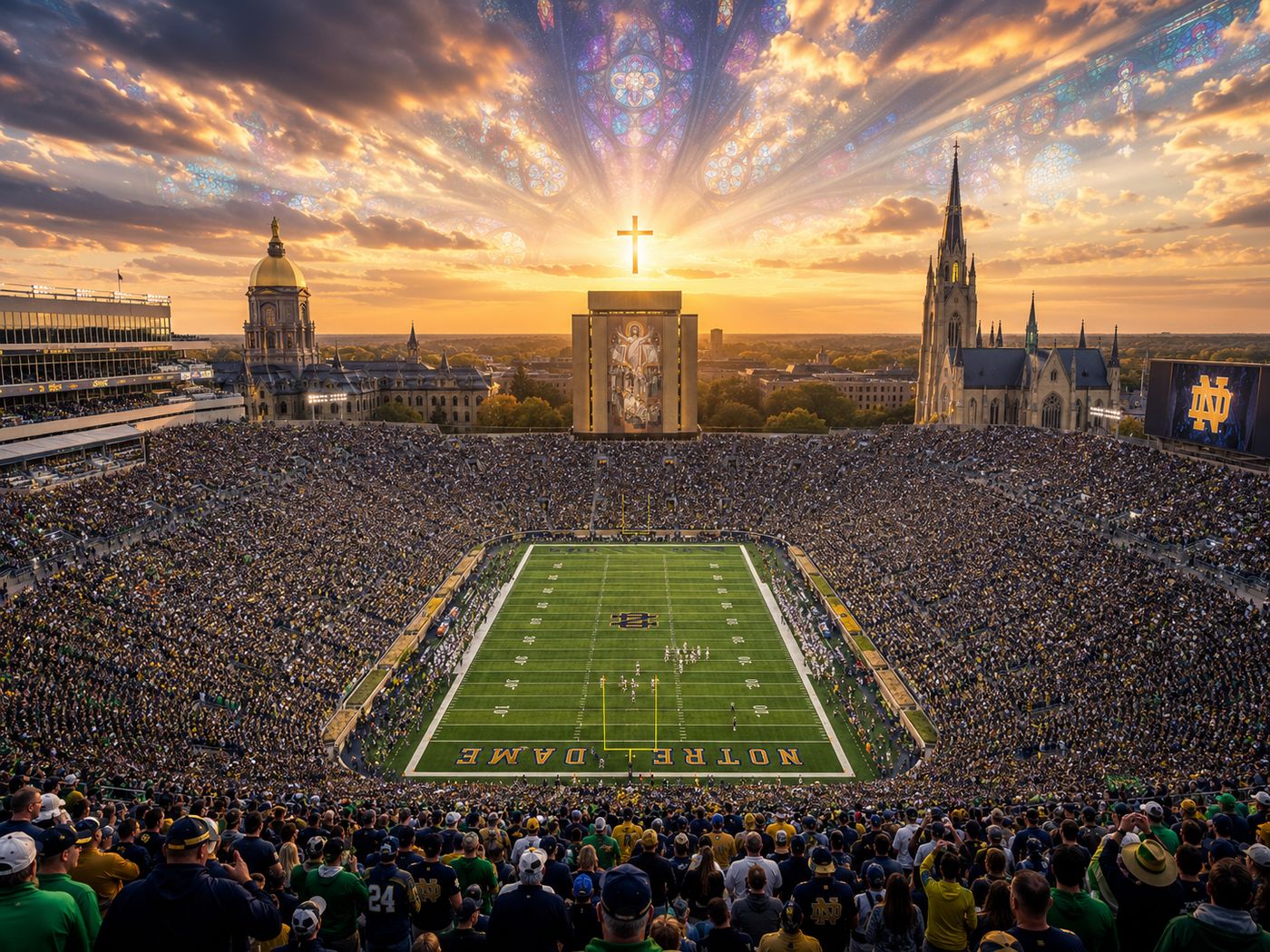
Notre Dame has spent the last two seasons getting painfully close to where it wants to be.
In 2024, the Fighting Irish reached the College Football Playoff National Championship Game before losing to Ohio State.
In 2025, Notre Dame started 0-2, ripped off 10 consecutive victories, finished 10-2, and then watched the College Football Playoff select someone else. The Irish were the first team left out.
Now comes 2026.
Notre Dame begins the season No. 4 in the AP Poll and No. 5 in the Coaches Poll. It has a potential Heisman-caliber quarterback, one of the best defensive players in America, a deep roster, an experienced coaching staff, and perhaps most importantly, a schedule that looks considerably more manageable than those facing several of the other national championship favorites.
So the question in South Bend is no longer whether Marcus Freeman has built Notre Dame into a legitimate national contender.
He has.
The question is much bigger:
Is this the year Notre Dame finally wins the national championship?
CJ Carr Changes Everything
The best reason to believe it might be is CJ Carr.
A year ago, Carr entered the season as an intriguing young quarterback with almost no meaningful college experience.
He exits 2025 as one of the most important returning quarterbacks in America.
Carr started all 12 games, completed 66.7 percent of his passes and threw for 2,741 yards and 24 touchdowns. He threw a touchdown pass in every game and had nine games with multiple touchdown throws.
The efficiency numbers were even more impressive.
Among returning Power Four quarterbacks, Carr ranked first last season in yards per completion at 14.06, second in yards per attempt at 9.35, and second in touchdown rate at 8.2 percent. Notre Dame finished second nationally in scoring at 41.8 points per game.
That is the key difference between this Notre Dame team and many of the Irish contenders of the past.
Notre Dame does not merely have a quarterback who can manage games.
It has a quarterback who can win them.
Carr threw for 354 yards and four touchdowns at Arkansas and 342 yards against NC State. He now enters his second full season as the starter with Mike Denbrock still coordinating the offense and Gino Guidugli still coaching quarterbacks.
Continuity at quarterback is rare in modern college football.
Notre Dame has it.
And Carr may only be getting started.
But the Irish Lost an Incredible Backfield
If there is one reason to temper the offensive expectations, it is impossible to ignore who is gone.
Jeremiyah Love and Jadarian Price are both in the NFL.
And they did not merely leave.
Love was selected No. 3 overall by Arizona, while Price went in the first round to Seattle. They became the first college teammates in the common draft era to be the first two running backs selected in the same NFL Draft.
Together, they accounted for 2,046 rushing yards and 29 touchdowns in 2025.
You do not simply replace that.
Love in particular gave Notre Dame something that changed the geometry of a defense. One missed tackle could become a touchdown. Price gave the Irish another starting-caliber back without forcing Love to carry the entire workload.
Their presence allowed Notre Dame to dictate games physically while simultaneously creating favorable opportunities for Carr.
That luxury is gone.
This year’s offense may have to look different.
Aneyas Williams Gets His Opportunity
The obvious candidate to take over is Aneyas Williams.
Williams rushed only 24 times last season but produced 224 yards and five touchdowns, an extraordinary 9.3 yards per carry.
Now the workload changes.
Williams is joined by Kedren Young, Nolan James Jr., Jonaz Walton and Javian Osborne in a backfield that is talented but largely unproven. Young missed the entire 2025 season due to injury after contributing as a freshman in 2024.
That may be Notre Dame's biggest offensive question.
The Irish do not necessarily need another Jeremiyah Love.
They need enough rushing production to keep defenses honest.
Carr is good enough that Notre Dame can become more pass-oriented.
But Marcus Freeman still wants an offense capable of physically controlling games.
If Williams and the rest of the backs can give Notre Dame that balance, the offense could remain among the nation's best.
Jaden Greathouse Is Almost Like Adding a Transfer
There is another important offensive piece returning.
Jaden Greathouse played only four games last season because of injury.
That means Notre Dame spent most of its 10-game winning streak without one of its most experienced receivers.
Greathouse is back for his senior season after catching only four passes for 73 yards in 2025.
His return could be significant.
So could the addition of Ohio State transfer Quincy Porter, a 6-foot-4 receiver now listed on the Notre Dame roster.
Notre Dame does not need one receiver to dominate the offense.
But Carr needs players capable of winning outside and creating explosive plays when defenses overload the box.
A healthy Greathouse combined with Porter and Notre Dame's younger receivers gives the passing game considerable upside.
The Offensive Line Could Make the Transition Easier
The Irish also have something every quarterback wants: experienced bodies up front.
Ashton Craig returns after starting the first six games last season before an injury ended his year. Notre Dame also brings back Anthonie Knapp, Guerby Lambert, Charles Jagusah, Sullivan Absher and Chris Terek among a deep collection of experienced offensive linemen.
That is important because the running back transition becomes much easier if the offensive line controls the line of scrimmage.
It also gives Carr the opportunity to become more aggressive.
Notre Dame's offensive formula in 2026 may shift from Love and Price creating everything while Carr punishes defenses for reacting, to Carr creating everything while the running game punishes defenses for respecting him.
That is not necessarily worse.
It is simply different.
Leonard Moore May Be the Best Cornerback in America
If Carr is the centerpiece of the offense, Leonard Moore is the face of the defense.
Moore enters 2026 as one of the country's most decorated returning players.
He was a unanimous All-American in 2025 and a finalist for the Jim Thorpe Award. He led Notre Dame with five interceptions, broke up seven passes and forced a fumble.
The advanced numbers were remarkable.
Moore earned a 91.8 overall PFF grade and a 92.5 coverage grade, both best in the nation. Opposing quarterbacks produced only a 45.9 passer rating when targeting him.
That gives defensive coordinator Chris Ash a luxury few coaches possess.
He can put Moore on one side of the field and make quarterbacks reconsider throwing there.
That changes how a defense can attack.
Safeties can shade elsewhere. Pressure packages become easier to disguise. Extra resources can be committed against the running game.
An elite cornerback affects much more than the player he covers.
Moore might be the most important non-quarterback on Notre Dame's roster.
And He Is Not Alone
This defense is far more than Leonard Moore.
Defensive lineman Boubacar Traore returns after leading Notre Dame with 6.5 sacks, 10 tackles for loss and eight quarterback hurries last season.
Safety Adon Shuler was second on the team with 53 tackles while adding two interceptions, two forced fumbles and five pass breakups.
Linebacker Kyngstonn Viliamu-Asa recorded 48 tackles, 7.5 tackles for loss and three sacks despite missing time.
Notre Dame also added intriguing defensive talent including Alabama transfer Keon Keeley, Colorado cornerback DJ McKinney, Oregon defensive lineman Tionne Gray and USC defensive lineman Elijah Hughes.
This might be the deepest defense Freeman has had.
That is saying something considering defense has been the foundation of his program.
Chris Ash Gets a Second Year
Continuity matters here too.
Chris Ash remains Notre Dame's defensive coordinator, with Aaron Henry serving as co-defensive coordinator and defensive backs coach.
That should allow Notre Dame to advance the scheme rather than install one.
The Irish already possess experienced players at every level.
They have an elite corner. They have pass rushers. They have depth at linebacker. And they have a head coach whose background is defense.
Notre Dame does not need to reinvent itself defensively.
It simply needs to become more consistent against the best offenses on the schedule.
That brings us to the most interesting part of this entire preview.
Notre Dame's Schedule Is Very Friendly for a Top Five Team
Compare Notre Dame's path with the schedules facing Ohio State, Oregon, Georgia and Texas.
Ohio State plays Texas, Indiana, USC and Oregon.
Oregon plays USC, Ohio State and Michigan.
Georgia goes to Alabama and Ole Miss while also playing Oklahoma.
Texas faces Ohio State, Tennessee, Oklahoma, Ole Miss, LSU and Texas A&M.
Notre Dame?
The Irish open against Wisconsin at Lambeau Field, then play Rice, Michigan State, Purdue, North Carolina and Stanford.
The first major road test arrives October 17 at No. 14 BYU.
After the bye, Notre Dame faces Navy before hosting No. 7 Miami, Boston College and No. 19 SMU, then finishes at Syracuse.
There are difficult games.
But there is no stretch resembling what Ohio State, Georgia or Texas must navigate.
Phil Steele ranks Notre Dame's 2026 schedule only 66th toughest nationally.
Among the preseason Top Five, that is an enormous advantage.
Wisconsin at Lambeau Is a Great Opening Test
Notre Dame does not get a meaningless tuneup.
The season begins Sunday night, September 6, against Wisconsin at Lambeau Field.
That is exactly the kind of opener that should have Freeman's attention.
National television. NFL stadium. Big Ten opponent. Neutral-site atmosphere. And an entire offseason of expectations packed into one evening.
Notre Dame should be favored.
But this is also the type of game that can become uncomfortable if the Irish spend the first half adjusting to life without Love and Price.
The good news is what follows.
Rice comes to South Bend. Then Michigan State. Then Purdue, North Carolina and Stanford.
If Notre Dame handles Wisconsin, the Irish have a realistic path to reach Provo 6-0.
That is where the season changes.
BYU Is the First Major Land Mine
The October 17 game at BYU could be much tougher than it looks on a national schedule graphic.
BYU begins the season No. 14 in the AP Poll.
Provo is a difficult place to play.
And the game comes after Notre Dame has spent much of the first half of the season as a substantial favorite.
This could be the classic game where an unbeaten team suddenly discovers that its margin for error has disappeared.
A Notre Dame victory could send the Irish into their bye week undefeated and very possibly inside the Top Three.
A loss would not end the playoff pursuit.
But because Notre Dame does not play in a conference championship game, every regular-season loss becomes magnified.
Last season already demonstrated that.
Then Miami Comes to South Bend
November 7 might be the defining game of Notre Dame's regular season.
No. 7 Miami comes to Notre Dame Stadium for a 7:30 p.m. kickoff.
It will be Miami's first visit to South Bend since 2016.
And nobody at Notre Dame will need reminding what happened the last time these programs affected each other's postseason futures.
Miami defeated Notre Dame in the 2025 opener, one of only two losses the Irish suffered all season.
When Notre Dame eventually finished 10-2 and Miami was also in the playoff conversation, the head-to-head result became impossible to ignore.
Now the Hurricanes come north.
This one has everything. Top 10 implications. Playoff implications. Revenge. Notre Dame Stadium at night.
If Notre Dame enters undefeated, this could become one of the biggest home games of the Freeman era.
SMU Is Another Game That Should Not Be Ignored
Two weeks later comes No. 19 SMU.
Again, the Irish get the advantage of playing at home.
But this is not simply another ACC scheduling obligation.
SMU has become a legitimate national program and gives Notre Dame another ranked opponent late enough in the season to strengthen its playoff case.
The late schedule is arranged nicely. Miami. Boston College. SMU. Syracuse.
Notre Dame avoids a brutal run of elite opponents on consecutive Saturdays.
That matters.
Independence Helps Notre Dame Here
There is another advantage that does not receive enough attention.
Notre Dame cannot play in a conference championship game.
That has disadvantages.
The Irish cannot win an automatic conference title, and they do not get an extra opportunity in December to add a major victory.
But there is also an obvious benefit.
They do not have to play a 13th game against another elite team before the playoff begins.
Ohio State, Oregon, Georgia and Texas could survive difficult regular seasons and then have to face another Top 10 opponent in the Big Ten or SEC Championship Game.
Notre Dame gets that weekend off.
For a team already starting in the Top Five, that can be valuable.
It reduces injury exposure. It eliminates one additional opportunity to lose. And it gives Notre Dame extra preparation time for whatever comes next.
The irony, of course, is that last season showed the downside.
Without a conference championship available, Notre Dame finished 10-2 and had no final opportunity to change the playoff committee's mind.
That memory should prevent anyone in South Bend from assuming that 10 wins will automatically be enough again.
That 2025 Snub Should Matter
Notre Dame's 2025 season was unusual.
The Irish started 0-2.
Then they did not lose again.
They won 10 straight games and finished 10-2, yet still missed the playoff.
That experience could become one of the most important psychological factors of 2026.
There should be no complacency.
There should be no assumption that the Notre Dame brand guarantees anything.
And there should be no confusion about the objective.
Marcus Freeman's message does not have to be complicated: do not give the committee a decision to make.
At 12-0, there is no argument.
At 11-1, Notre Dame should be safely positioned.
At 10-2?
Last year already answered that question.
Nobody wants to find out twice.
Marcus Freeman Has Built This Into His Program
It is worth recognizing how far Notre Dame has come under Freeman.
His first full season finished 9-4.
Then came 10-3.
Then 14-2 and a trip to the national championship game.
Then 10-2 with the disappointment of missing the playoff.
Notre Dame is no longer trying to prove it can belong in national championship conversations.
It is already there.
The program now recruits nationally. It develops NFL players. It has stability at quarterback. It has coordinators with significant experience. It has an elite defense. And it has enough depth that injuries no longer automatically destroy an entire position group.
The standard has changed.
A 10-win season at Notre Dame is no longer automatically viewed as a major accomplishment.
That is what Freeman has created.
So Is Notre Dame Overrated?
This will be one of the arguments surrounding the Irish all season.
Notre Dame is No. 4.
Its schedule ranks 66th in difficulty.
It does not have to play a conference championship game.
There will inevitably be complaints that teams in the SEC and Big Ten are navigating much tougher paths.
That criticism is not entirely unfair.
But schedule difficulty and team quality are different questions.
Notre Dame cannot control whether Wisconsin, Michigan State or Stanford are elite in 2026.
What it can control is what happens when those teams line up across from it.
If the Irish are truly one of the four best teams in the country, they should look like it.
They should not need fourth-quarter escapes against mediocre opponents.
They should overwhelm teams. They should arrive at BYU unbeaten. They should beat Miami at home.
They should enter November looking less like a team trying to qualify for the playoff and more like a team preparing to win it.
The Biggest Question Is the Running Game
For all the discussion about Carr, Moore, Freeman and the schedule, Notre Dame's season may ultimately come down to one personnel question:
How much does the offense miss Jeremiyah Love and Jadarian Price?
If the answer is a lot, Notre Dame could still be very good.
Carr is talented enough to carry a bigger workload. The defense is talented enough to keep scores manageable. The schedule is favorable enough to absorb some offensive growing pains.
But if Aneyas Williams, Kedren Young and the younger backs produce anything close to a championship-level rushing attack?
Then Notre Dame becomes one of the most complete teams in the country.
Because the passing game is already there. The quarterback is already there. The defense is already there.
TD Strike Prediction
Notre Dame might have the cleanest path to the College Football Playoff of any preseason Top Five team.
That does not mean the Irish are automatically better than Ohio State, Oregon, Georgia or Texas.
It means they have fewer opportunities for something to go wrong.
CJ Carr should take another step forward. Leonard Moore could be the best defensive back in college football. Boubacar Traore gives the Irish an established pass rusher. Jaden Greathouse returns. The offensive line has experience. And Marcus Freeman has already taken Notre Dame to a national championship game.
The obvious question is running back.
The other potential danger is the schedule itself. When a team is favored almost every week, one upset becomes much more damaging.
But this roster should be good enough to handle that pressure.
Prediction: Notre Dame finishes 11-1, earns a College Football Playoff berth and enters December as one of the four or five teams with a legitimate chance to win the national championship.
The most likely loss comes at BYU or against Miami.
But 12-0 is entirely realistic.
That is why 2026 feels different.
Two years ago, Notre Dame proved it could reach the national championship game.
Last year, it learned how painful it can be to leave its fate in the hands of a committee.
This season, the Irish have a quarterback, a defense and a schedule capable of removing almost every excuse.
For Notre Dame, simply making the playoff is no longer enough.
The next step is winning the whole thing.