

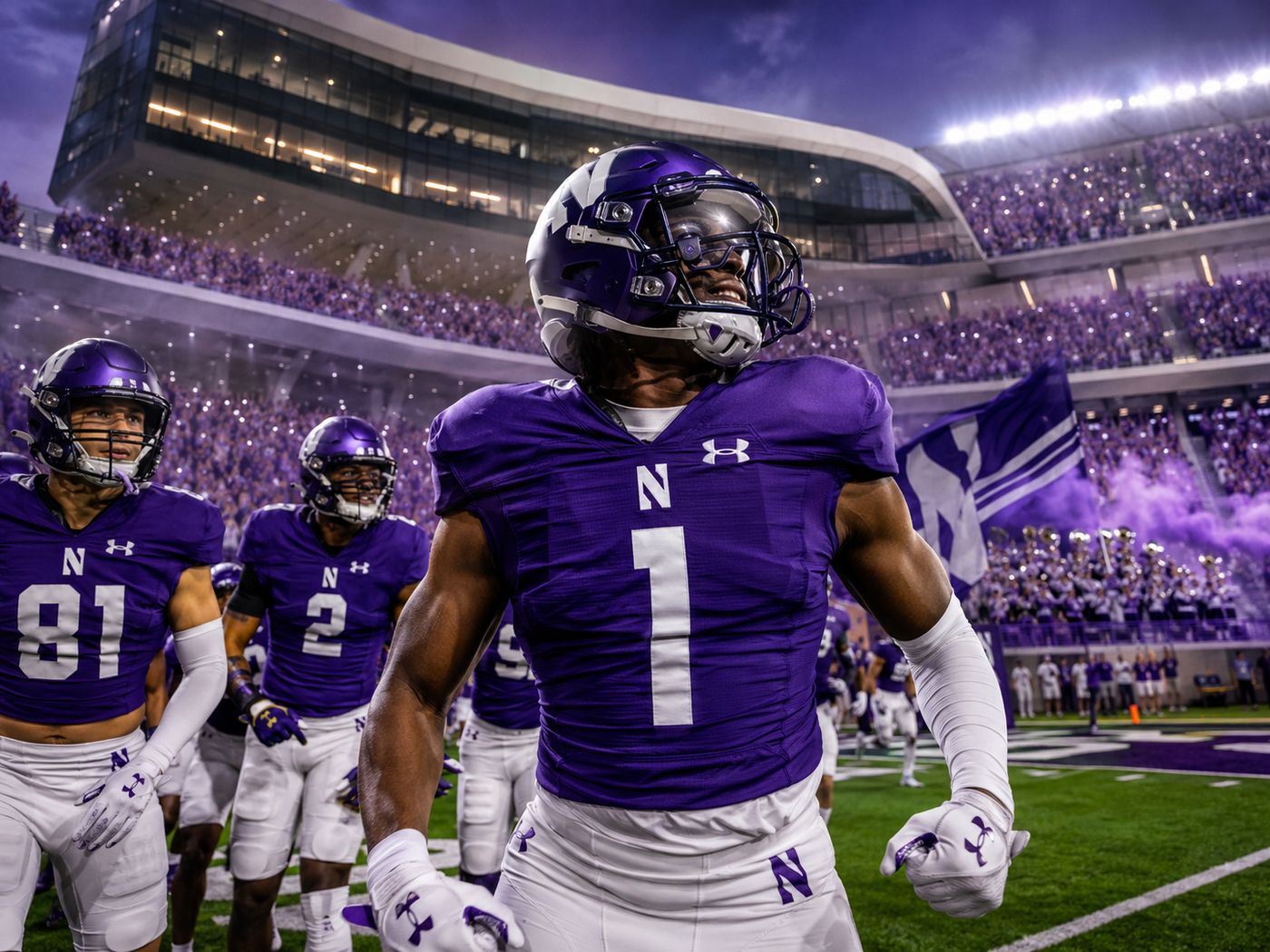
For Northwestern football, 2026 is about much more than another season.
It is about opening a new era.
The Wildcats will play their first game in the new Ryan Field on October 2 against Penn State, exactly 100 years to the day after the original stadium hosted its first football game in 1926. The $870 million stadium gives Northwestern one of the most modern venues in college football and, potentially, something the program has rarely possessed: a true home-field advantage.
That makes the central question surrounding Northwestern in 2026 especially interesting.
Can David Braun take a program that went 7-6 last season, add Chip Kelly running the offense and Aidan Chiles at quarterback, and use the excitement surrounding Ryan Field to push Northwestern into a different tier of the Big Ten?
Because for the first time in years, the biggest story in Evanston may not be what Northwestern lacks.
It may be what Northwestern has suddenly built.
First, Northwestern Is Coming Off a Winning Season
It is easy to forget that Northwestern actually enters 2026 with some momentum.
The Wildcats finished 7-6 overall and 4-5 in the Big Ten last season, then dominated Central Michigan 34-7 in the GameAbove Sports Bowl. It was Northwestern's sixth consecutive bowl victory dating back to 2016.
That season was not spectacular.
But it mattered.
Braun has now taken Northwestern to bowl games in two of his first three seasons, and the Wildcats have begun establishing the kind of identity that made the program dangerous during its best years: physical defense, limited mistakes and the ability to drag opponents into uncomfortable games.
Now comes the interesting part.
Northwestern is trying to add offense.
And it hired one of college football's most recognizable offensive minds to do it.
Chip Kelly at Northwestern Is Fascinating
Chip Kelly is Northwestern's offensive coordinator.
That still sounds strange.
But it might be one of the most intriguing coordinator hires in the country.
Kelly has been an NFL head coach, the head coach at Oregon and UCLA, and the offensive coordinator at Ohio State during the Buckeyes' 2024 national championship run. That Ohio State offense averaged 36.3 points during its four College Football Playoff victories.
Now Kelly is in Evanston.
He is not being asked to recreate the blur offense that made Oregon revolutionary 15 years ago. Modern Kelly offenses have evolved considerably.
But the fundamental idea remains the same: put players in favorable situations, create numbers advantages and make the quarterback's decisions easier.
That could be exactly what Northwestern needs.
The Wildcats have too often entered Big Ten games hoping to score 20 points and let their defense do the rest.
Kelly gives Northwestern a chance to become considerably less predictable.
And he has an interesting quarterback to work with.
Aidan Chiles Gets Another Chance
Michigan State transfer Aidan Chiles has won Northwestern's starting quarterback job.
Chiles arrives with significant experience. He started 20 games during two seasons at Michigan State after beginning his career at Oregon State.
Last season, he completed 63 percent of his passes for 1,392 yards, 10 touchdowns and only three interceptions while also rushing for six touchdowns before an injury ended his season early.
There has never been much question about Chiles' physical ability.
He is 6-foot-4, around 225 pounds, athletic and capable of making difficult throws.
The question has always been consistency.
That is what makes the pairing with Kelly so compelling.
If Kelly can simplify the game for Chiles, use his mobility and create throws off the running game, Northwestern could have its most dangerous quarterback in years.
And Chiles is not arriving merely as a hired transfer.
He was already named one of Northwestern's six captains.
That tells you how quickly he has taken ownership of the offense.
Griffin Wilde Gives Him a Proven Target
Northwestern also returns one of the most productive receivers in the Big Ten.
Griffin Wilde caught 71 passes for 880 yards and eight touchdowns last season after transferring from South Dakota State.
His 880 receiving yards were the most by a Northwestern player since 2016, and he finished third in the Big Ten in receptions and sixth in receiving yards.
That matters tremendously for Chiles.
A transfer quarterback walking into a new system is much more comfortable when he already knows where the football should go on third-and-7.
Wilde can be that player.
Northwestern also has running back Joseph Himon II, another team captain who rushed for 486 yards last season while contributing as a receiver and kick returner.
And perhaps the most important offensive player who does not touch the football may be center Jackson Carsello.
Carsello started every game last season and earned a 79.8 PFF grade, tied for fourth nationally among centers. His run-blocking grade ranked fourth in the country at the position.
That gives Kelly several useful building blocks.
Northwestern does not suddenly have Ohio State's roster.
But it may have enough talent for Kelly to create something interesting.
The Defense Still Has to Be Northwestern
The arrival of Kelly should not change what Braun wants Northwestern to be.
Braun built his reputation on defense.
And the Wildcats still have experienced pieces on that side of the football.
Linebacker Braydon Brus returns after recording 81 tackles, 4.5 tackles for loss, 2.5 sacks, two forced fumbles and four pass breakups last season.
Defensive back Robert Fitzgerald was even more productive.
Fitzgerald recorded 115 tackles, second most in the Big Ten, including a conference-leading 70 solo tackles. He enters 2026 on the Bednarik Award watch list and gives Northwestern one of the league’s most experienced defensive backs.
The Wildcats showed what this defense can look like in the bowl game.
Northwestern forced four Central Michigan turnovers, converted all four into touchdowns and won 34-7.
That is Northwestern football.
Kelly does not need to turn this into a 45-point offense.
If Northwestern can become an offense capable of consistently scoring in the upper 20s while Braun's defense continues creating turnovers and limiting explosive plays, the Wildcats become much harder to beat.
And Then There Is Ryan Field
Everything about this season eventually comes back to the stadium.
The new Ryan Field is not simply a renovated version of the old building.
It is a complete reinvention.
The stadium has a 35,000-seat capacity, significantly smaller than many Big Ten venues, but that is intentional. Northwestern designed it to bring fans dramatically closer to the field and create something closer to an arena atmosphere than a traditional college football bowl.
The project cost approximately $870 million, making it the most expensive college football stadium ever built, according to the stadium project.
But the most interesting feature might be the student section.
The Wildcat Wall Could Be Something Completely Different
Northwestern is calling it the Wildcat Wall.
Instead of a normal end-zone student section, approximately 2,000 students will occupy a steep, European soccer-inspired safe-standing section directly behind the south end zone.
The section rises at 33 degrees, creating what Northwestern hopes will be a wall of sound immediately behind opposing offenses.
That may sound like stadium marketing.
But think about what Northwestern's home environment has historically been.
Visiting fan bases have frequently taken over large portions of Ryan Field.
When Ohio State, Michigan, Wisconsin or Nebraska came to Evanston, there were Saturdays when Northwestern appeared to be playing a road game on its own campus.
The new stadium is designed specifically to prevent that feeling.
Smaller capacity. Fans closer to the field. A canopy covering seating areas. A steep student section. More concentrated noise.
Northwestern does not need Ryan Field to become Beaver Stadium.
It just needs Ryan Field to stop feeling like a neutral field.
That alone could matter.
Penn State Gets the First Look
The opening could hardly have been scripted better.
Northwestern will play its first two home games against South Dakota State and Colorado at its temporary lakefront home, Northwestern Medicine Field at Martin Stadium.
Then the Wildcats travel to defending national champion Indiana.
And six days later: Penn State comes to Evanston.
Friday night. October 2. 7 p.m. Central. FOX.
The first game ever played in the new Ryan Field.
Exactly 100 years after the original stadium opened.
That could be one of the most emotionally charged games Northwestern has played in years.
Imagine the Wildcats pulling off an upset in that environment.
Ryan Field would instantly acquire something no architect can build: a memory.
That is how home-field advantages begin.
The Stadium Is Bigger Than One Game
For Northwestern, Ryan Field is also a statement about what the football program wants to become.
Northwestern will never recruit exactly like Ohio State.
It probably will never build a 100,000-seat stadium.
It does not need to.
Its pitch can be different.
Come play in the Big Ten. Live minutes from Chicago. Attend one of the country’s most prestigious universities. Train in high-end facilities. Play in an NFL-style stadium. Compete against Ohio State, Oregon, USC, Michigan and Penn State.
That is a significantly stronger recruiting presentation than Northwestern had five years ago.
Ryan Field could matter more in recruiting than it does on Saturdays.
And that may ultimately be its greatest value.
Unfortunately, the Schedule Is Brutal
There is one major problem with imagining a breakthrough season.
Look at where Northwestern has to play.
After South Dakota State and Colorado, Northwestern travels to defending national champion Indiana.
Then comes the Ryan Field opener against Penn State.
Later, Northwestern travels to Oregon.
Two weeks after that, it travels to Ohio State.
That means the Wildcats play three of the most powerful programs in the Big Ten away from home.
And there is another hidden difficulty.
After an early open week, Northwestern plays 11 consecutive games from September 19 through November 28.
There is no late-season break.
That is difficult for any team, especially one without the roster depth of Ohio State or Oregon.
The Middle of the Schedule Will Determine the Season
The Wildcats are unlikely to build their record against Indiana, Oregon and Ohio State.
The season will instead be decided by the games around them.
After Penn State, Northwestern hosts Ball State. Then comes at Michigan State, Rutgers, at Oregon, Iowa, at Ohio State, at Minnesota and Illinois.
Michigan State, Rutgers, Iowa, Minnesota and Illinois are the games that matter most.
Win three or four of those and Northwestern probably reaches another bowl.
Win four or five and this becomes a genuinely successful season.
That is the challenge of being Northwestern in today's Big Ten.
You do not need to beat Ohio State.
You need to consistently beat the programs occupying the huge middle of the conference.
Colorado Is an Important Early Test
Do not overlook Northwestern's September 19 game against Colorado.
South Dakota State is one of the best FCS programs in the country and is hardly an automatic opener.
Then Colorado comes to the lakefront for a prime-time game.
Northwestern needs to enter the Indiana and Penn State stretch with confidence.
Starting 2-0 changes the psychology of the season.
Starting 1-1 or 0-2 makes the upcoming schedule look considerably more intimidating.
The Wildcats cannot spend September waiting for Ryan Field to open.
They have to arrive there with something already built.
What Is a Successful Season?
For Northwestern, context matters.
A 7-5 regular season would be legitimately impressive against this schedule.
Eight wins would represent a significant step forward.
Anything beyond that would mean Northwestern probably pulled off at least one major upset.
The Wildcats are not built to compete with Ohio State and Oregon snap-for-snap yet.
But they may be considerably more dangerous offensively than they were last season.
And that creates possibilities.
TD Strike Prediction
There are enough reasons to be optimistic about Northwestern.
Aidan Chiles gives the Wildcats a talented veteran quarterback. Chip Kelly gives them one of the most accomplished offensive coordinators in college football. Griffin Wilde is a proven Big Ten receiver. Jackson Carsello anchors the offensive line. Braydon Brus and Robert Fitzgerald provide veteran leadership on defense.
And David Braun has already demonstrated that he can get Northwestern to a bowl game.
Then, on October 2, Northwestern gets something completely new. Ryan Field.
The stadium will not turn Northwestern into Ohio State.
But it could help change what playing Northwestern in Evanston feels like.
That is important.
The schedule probably puts a ceiling on how far the Wildcats can climb in 2026. Road games against Indiana, Oregon and Ohio State are an extraordinarily difficult trio, while Penn State comes to town for the stadium opener.
But the rest of the schedule contains opportunities.
Prediction: Northwestern finishes 7-5, reaches another bowl game and produces at least one upset that makes the rest of the Big Ten take notice.
And the most interesting prediction may have nothing to do with the final record.
By the end of this season, people may stop talking about Ryan Field simply as Northwestern’s beautiful new stadium.
They may start talking about it as a difficult place to play.
For Northwestern football, that would be a significant development.
The Wildcats have spent the last few seasons rebuilding a program.
In 2026, they finally get to open the building that represents where they want that program to go.