

College football has officially begun its annual ritual of arguing about teams that have not played a game yet.
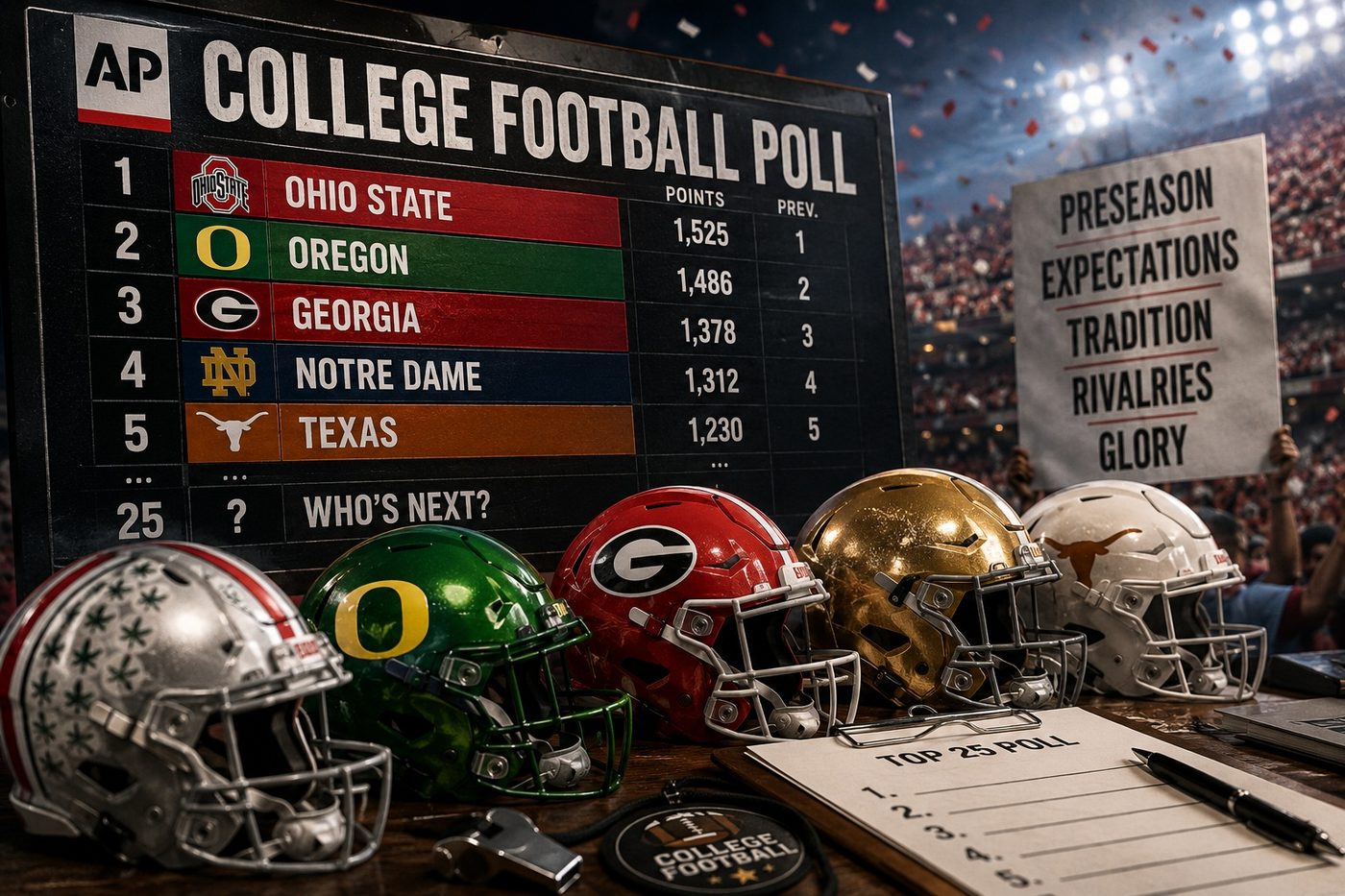
The Associated Press released its preseason Top 25 this week, putting Ohio State at No. 1, followed by Oregon, Georgia, Notre Dame and Texas. Defending national champion Indiana enters the season at No. 6, while Miami is No. 7. The SEC has nine teams in the poll, the Big Ten has eight, and the Big 12 has four.
The most notable headline may be at the very top. Ohio State and Oregon give the Big Ten the No. 1 and No. 2 teams for only the second time in AP preseason poll history and the first time in 65 years. Ohio State received 40 first-place votes, while Oregon received 14.
But the more interesting question isn't necessarily whether Ohio State deserves to be No. 1.
It's why these rankings matter so much when, at the moment the poll was released, every team is 0-0.
A Prediction, a Narrative and a Business Tool
Preseason polls have always been part prediction and part cultural touchstone. Fans want something to argue about before the first kickoff, and college football has developed an entire industry around those arguments.
But the rankings also have economic consequences.
A preseason ranking gives a program immediate national visibility. It changes the way a game is promoted, how television networks present a matchup and how fans perceive the importance of a game. A Week 1 matchup between two highly ranked teams has an entirely different promotional value than the same game would have if both teams were unranked.
That makes the AP poll more than a list of opinions. It becomes an early-season narrative-setting mechanism.
And this is where the preseason poll can become self-reinforcing.
The Problem of Poll Inertia
One of the biggest problems with preseason rankings is what might be called poll inertia.
Suppose Team A begins the season ranked No. 5 and loses a close game. Team B begins unranked and goes 5-0.
Team A is likely to remain somewhere in the rankings because voters already believed Team A was good. Team B, meanwhile, has to demonstrate its quality repeatedly before receiving the same level of recognition.
That creates an anchoring effect.
The initial ranking becomes the baseline from which future judgments are made.
There is another consequence: ranked teams create ranked wins.
If Team A begins No. 10 and Team B beats it in September, Team B can later point to a victory over a Top 10 opponent. But if Team A subsequently falls out of the rankings, that "ranked win" may look very different by November.
The preseason poll therefore doesn't simply predict the season. It can influence the way the season's results are interpreted.
Last Year's Lesson
College football doesn't have to look very far for an example of how difficult preseason predictions can be.
Last year's preseason AP poll had Texas No. 1, Penn State No. 2 and Alabama No. 8. By the end of the season, only Alabama narrowly made the College Football Playoff, while Indiana, which began the season at No. 17, emerged as the national champion.
That is a remarkable reminder of the difference between reputation and performance.
This year's poll puts Indiana at No. 6 despite its 16-0 championship season, with the biggest question being how the defending champion handles a quarterback transition.
The question is whether voters are appropriately recognizing what Indiana accomplished or whether they are still relying heavily on traditional assumptions about which programs are most likely to contend.
The Television Effect
There is also a straightforward business reason to pay attention to the rankings.
Television networks sell college football through stories: No. 1 versus No. 5, a conference showdown, a potential playoff preview, a traditional power trying to reclaim its place.
Preseason rankings help create those stories before there are any results.
This year's schedule illustrates the point immediately. No. 1 Ohio State travels to No. 5 Texas on Sept. 12, while No. 10 Oklahoma visits No. 16 Michigan on the same date. Those games already have a national storyline attached to them because the AP rankings have established the stakes.
If the rankings were dramatically different, the promotional narrative surrounding those games would be different as well.
That doesn't mean the rankings are created for television. It does mean that television benefits enormously from the existence of a preseason hierarchy.
Recruiting and Program Prestige
The effect extends beyond television.
Being ranked nationally is valuable marketing for a college football program. A highly ranked team gets more national exposure, more discussion and more visibility among recruits and transfers.
Coaches can point to preseason expectations as evidence that their program is viewed as a national contender.
That matters in an era when recruiting, transfers and NIL have become central components of roster construction.
A program that repeatedly appears near the top of the rankings develops something that is difficult to measure statistically: perception of importance.
And perception can become a competitive advantage.
Does the AP Poll Influence the Playoff?
There is an important distinction here.
The AP poll does not determine the College Football Playoff rankings. The CFP Selection Committee produces its own rankings beginning later in the season.
But that doesn't mean the preseason poll is irrelevant to the playoff conversation.
By the time the committee begins evaluating teams, months of narratives have already developed around which teams are contenders, which conferences are strong and which victories are impressive.
The AP and Coaches polls help establish that vocabulary.
In fact, the AP has already demonstrated how easily its preseason rankings can be translated into a hypothetical playoff bracket. Based on the preseason AP rankings, Ohio State, Oregon, Georgia and Notre Dame would occupy the top four positions, with Texas, Indiana, Miami and Texas A&M hosting first-round games.
Of course, that isn't a playoff projection in any official sense. It is simply an illustration of how preseason rankings can immediately create a playoff narrative.
The Most Interesting Teams May Not Be No. 1
The real intrigue in this year's poll may be below Ohio State.
Indiana at No. 6 is fascinating because the Hoosiers are coming off a perfect championship season but must prove they can sustain that success.
Alabama at No. 13 is another major storyline. It is the Crimson Tide's lowest preseason AP ranking since 2008.
Texas Tech at No. 12 is another interesting development, while Houston returns to the poll at No. 23. Clemson, meanwhile, received 112 votes but did not make the Top 25.
Those teams may ultimately tell us more about the usefulness of the preseason poll than Ohio State does.
If Ohio State wins the national championship, the preseason voters will look brilliant.
If the Buckeyes struggle and an unranked team eventually wins the title, the preseason poll will look much more like what it actually is: an educated guess based on incomplete information.
The Poll Is Not Supposed to Be Perfect
Perhaps that's the right way to view the AP Top 25.
It isn't a prediction of the final standings. It is a starting point.
The danger comes when a starting point becomes an assumption.
College football is particularly susceptible to this because the sport has enormous differences in program resources, historical reputation and national visibility. A traditional powerhouse can lose and remain highly ranked, while a rising program may need months of success before receiving comparable recognition.
The 2026 preseason poll gives us a hierarchy.
The games will determine whether that hierarchy survives.
And that may be the most entertaining part of the entire exercise.
For the next several months, every upset, close call and unexpected breakout will test the assumptions contained in 25 numbers published before anyone had played a game.
The AP poll starts the conversation.
It doesn't finish it.